kyle hobson
Menu

APPLIED AI · WORKFLOW DESIGN & ENABLEMENT

Good AI work starts
with a clear task.

I’m Kyle. I turn open-ended AI requests into clear workflows, testable instructions, and learning experiences people can use. My work connects product research, prompt engineering, and the judgment of the person using the result.

AI analysis at ASU. Independent tools. Published teaching.

CLARE & AI Glossary

From reference to practice

“Help me write an invitation.”

ContextA beginner AI workshop
AudienceFirst-time AI users
OutputA clear invitation brief

CLARE turns a framework into a worksheet you can inspect.

Featured work CLARE: from reference to a usable prompt brief.
SELECTED EXPERIENCE

Arizona State UniversityAI analysis

CourseraGuided Project instructor

FactorLabHuman–AI interaction

Independent toolsPrompt + research workflows

SELECTED WORK

Build the workflow. Inspect the evidence. Teach the habit.

Follow the work from the problem to the decisions that shaped it.

01KNOWLEDGE DESIGN · PROMPT WORKFLOWS

From collecting AI knowledge to putting it to work.

A glossary became a workspace for choosing a framework, shaping a prompt, and checking what still needs thought.

Creator · research, experience design & AI-assisted development · 2024–2026

Explore the case

CLARE & AI Glossary

From reference to practice

“Help me write an invitation.”

ContextA beginner AI workshop
AudienceFirst-time AI users
OutputA clear invitation brief

CLARE turns a framework into a worksheet you can inspect.
02TOOL DESIGN · HUMAN REVIEW

Give AI work a repeatable review path.

I built a family of focused tools for reviewing prompts, examining claims, tracing research, and evaluating interfaces. Each has a different job and an explicit point for human judgment.

Creator · workflow design, tool contracts & AI-assisted implementation · 2026

Explore the case
Compasses & MCPs

A family of focused tools

Make the next decision clearer.

PromptPreserve the requirements
CriticalQuestion the claim
UXTrace the finding

Shared review habits. Distinct tools and evidence needs.

04EVIDENCE RETRIEVAL · RESEARCH OPERATIONS

Make the answer traceable to the evidence.

A read-only research tool gives an AI assistant a path back to source evidence, with stable references and visible gaps.

Independent creator · research workflow and tool development · 2026

Explore the case
Oppia Research Compass

Evidence retrieval

Where did that answer come from?

QuestionDefine what to investigate
SourceOpen the exact evidence
AnswerKeep its limits attached

Oppia Research Compass connects a claim back to its source.

IN PRACTICE · ARIZONA STATE UNIVERSITY

Put the mentor’s judgment into the workflow.

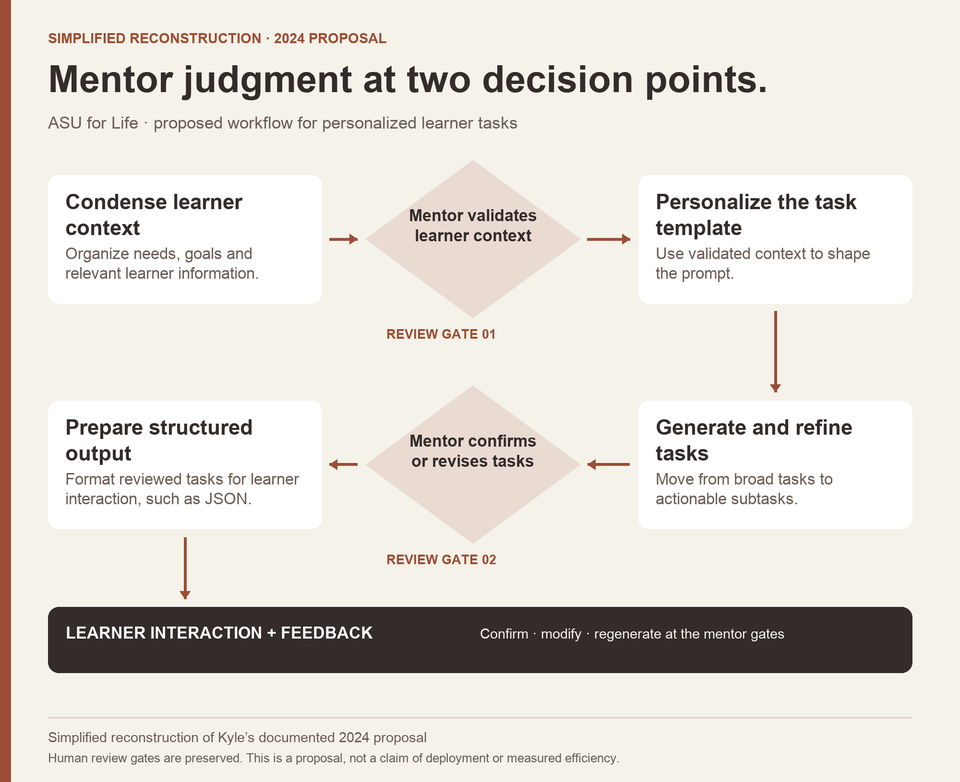
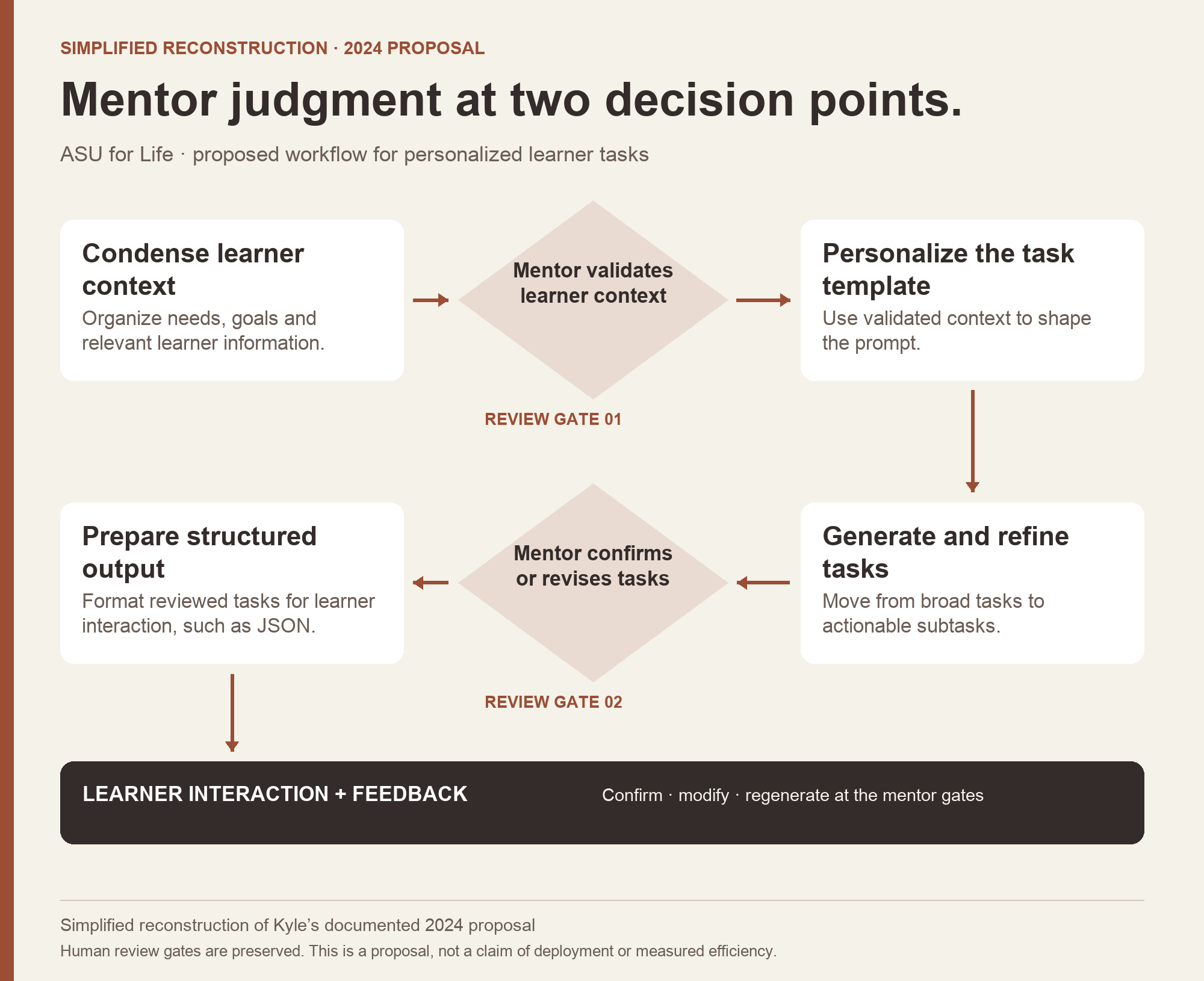
As an AI Analyst at ASU Learning Innovations in 2024, I proposed a staged workflow for personalized learner tasks. A mentor would validate the learner context, then review or revise generated tasks before they reached the learner. The proposal made those review points part of the process.

Proposed workflow · 2024

  1. 01

    Learner context

    Summarize the information that shapes the task.

  2. 02

    Mentor validates

    Check the context before generating.

  3. 03

    Generate & refine

    Develop a task from the reviewed context.

  4. 04

    Mentor reviews

    Confirm or revise before the learner receives it.

Inspect the proposal diagram
Simplified reconstruction of Kyle’s 2024 ASU proposal: learner context, mentor validation, task generation and refinement, mentor review, structured output, and feedback.
Simplified reconstruction of my 2024 proposal · deployment and time savings were not established

THE THREAD THROUGH MY WORK

The tool changes.
The listening stays.

Kyle Hobson, supplied portrait.

A good question can change
the whole story.

My route into AI runs through documentary storytelling, communication, learning design, and UX research. Each taught me to ask who the work is for, what they are trying to do, and what would help them move forward.

As an AI Analyst at Arizona State University, I worked on conversational experiences and proposed learner-support workflows. In my independent tools and teaching, I keep coming back to the same practical question: what does the person need to judge? A prompt revision can lose a requirement. A source bundle can be too narrow. A more vivid draft can add a claim nobody supplied.

I like making those moments visible enough to discuss and act on. Outside product work, I run tabletop games: another setting where a useful structure still depends on listening, adapting, and paying attention to the people in it.

MS, User ExperienceArizona State University · 2024 Also: UX communication, electronic media,
and a lifelong interest in how people think.

Useful at the point where possibility becomes work.

AI workflow analysis

Clarify the task, the people involved, the constraints, and where a human decision belongs before choosing an AI approach.

Prompt design & evaluation

Make requirements explicit, compare versions, and look for the failure a more polished answer might hide.

Teaching & enablement

Turn a tool into a repeatable practice through concrete examples, guided exercises, and understandable review criteria.

How I make AI work inspectable

Clear requirements, visible limits, and a person who can judge the result.

What do you test when a prompt changes?

Whether the original requirements survive. A Prompt Compass fixture catches a rewrite that drops four required field names. That check inspects prompt text; it does not prove a model will return valid JSON. I keep the next output-level test explicit instead of presenting a heuristic result as end-to-end reliability.

Inspect the regression fixture
How do you work with people who need to trust the answer?

I make the review point part of the workflow. My ASU learner-support proposal gives a mentor responsibility for validating learner context and reviewing generated tasks. The retained design shows where that judgment belongs and what the mentor can revise. It remains a proposal.

See the mentor review points
How do you adapt to incomplete evidence?

I make missing coverage visible before asking for a conclusion. Research Compass distinguishes source records, retrieved evidence and the next research question. It gives the reviewer a way to inspect the archive and decide what to investigate next; source coverage and summary accuracy still need human review.

Explore the source-coverage workflow

TAKE THE STORY WITH YOU

The Applied AI package.

A concise career overview and a visual walkthrough of the work.

A GOOD PLACE TO START

Let’s find the useful part of AI for your team.

For applied AI consulting, AI analysis, prompt design, enablement, and human–AI product work.

Mesa, Arizona · Open to remote collaboration LinkedIn GitHub
Open original