
 Selected work
Arizona State University / LEARNING EXPERIENCE · AI WORKFLOW
Keep a mentor in the learning loop.
As an AI Analyst at ASU, I proposed a learner-support workflow with human review before generated tasks reached the learner.
3 min read
- The learner need
- A next task that fits the learner’s context.
- My contribution
- Proposed task workflow and human review checkpoints.
- The proof
- Original proposal and flowchart; a labeled simplified view.
THE CONTEXT
Give the mentor a clear place in the process.
The ASU for Life prompt-architecture document was collaborative. It considered how learner context could inform useful tasks while keeping a mentor involved in the decisions.
MY CONTRIBUTION & COLLABORATION
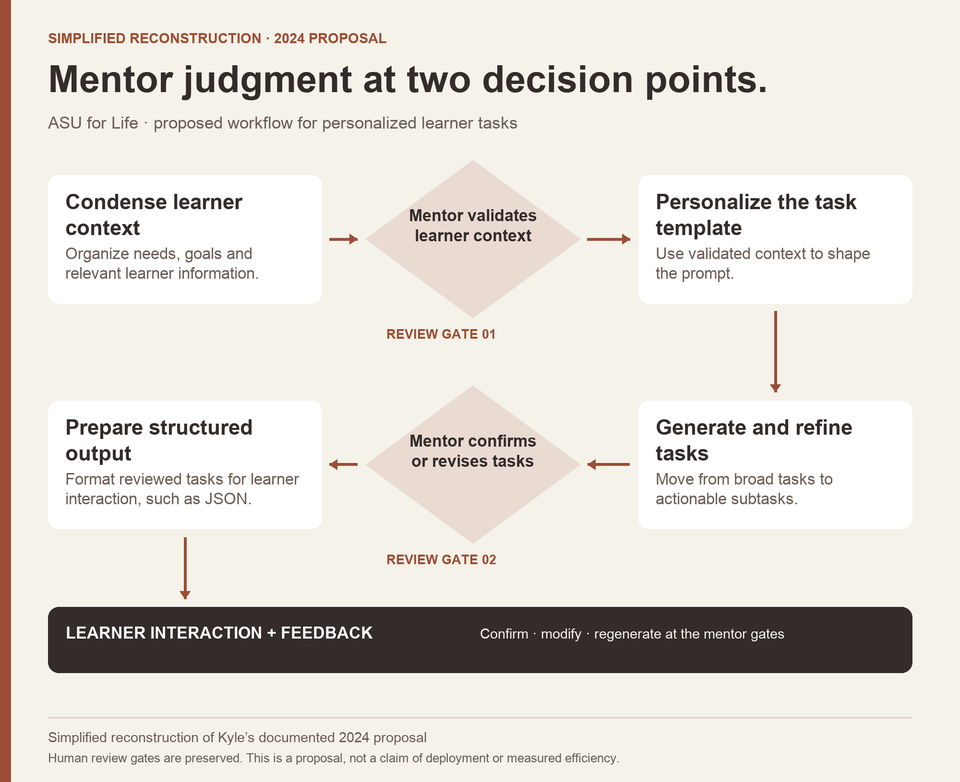
I contributed a staged workflow and a Figma flowchart that make two mentor checkpoints visible. The shared architecture document supplies the wider context; my design contribution is the sequence and the decisions a mentor would review. This is a documented proposal.
DECISION 01
Check the learner context before generating the next task.
My proposal condensed learner information, then gave the mentor a point to validate or revise that context. The check was intended to catch a misinterpretation before it became the basis for later suggestions.
DECISION 02
Give the mentor a decision, not just a finished answer.
A second review point sat after task generation and refinement. The mentor could confirm or modify the output before tasks moved toward the learner. That made responsibility visible in the proposed workflow.
Two different judgments for the mentor
| Checkpoint | Question to resolve | Next step |
|---|---|---|
| Before generation | Does this context accurately represent the learner? | Confirm or revise the context |
| After task refinement | Is this an appropriate task for this person? | Confirm or modify the output |
OUTCOME & REFLECTION
A proposal with review built into the sequence.
The original proposal and flowchart make two mentor checkpoints explicit: validate the learner context, then review the generated tasks. My workflow-design contribution was to show where professional judgment belongs and what the mentor can revise.
The participation journey starts before the activity.
My workshop work reinforced the same concern in a different form. Before an April 2024 AI event, I asked attendees what they wanted from the session. An ASU-only Zoom setting nevertheless blocked external attendees. I acknowledged the problem and offered remedies. That experience makes access setup part of how I think about learning design: an activity cannot help someone who cannot enter it.
The next question I would test
For a future session, test the actual invitation and tool access as an external attendee, and make an alternative participation route visible.
Original 2024 collaborative ASU for Life prompt-architecture document and Figma flowchart. The image is a simplified portfolio reconstruction of the proposal, not a deployed product screenshot. Deployment, learner results and time savings were not established by these artifacts.
KEEP EXPLORING