
 Selected work
Coursera · Guided Project / INSTRUCTIONAL DESIGN · COURSE PRODUCTION
Teach the judgment behind a better prompt.
A published guided project, built around a practical content task. Reviewer feedback led me to revise answer choices, application questions and retry feedback.
8 min read
- The learner task
- Draft and revise a social post for the fictional Brew Bliss café.
- My contribution
- Course design, scripts, slides, recorded instruction and documented assessment revisions in response to production review.
- The proof
- Published course, original teaching excerpts, and a reviewer-to-revision assessment record.
SEE THE TEACHING · 1 min 24 sec
Watch one minute of the lesson
I demonstrate how a café’s audience, a hook, and a call to action change the prompt. The learner is then asked to refine the audience or tone further.
Watch the teaching excerpt on YouTube
Edited teaching excerpt · 2024 · narration enhanced during production with Adobe tools and ElevenLabs. This is course instruction, not live workshop footage.
Read the clip summary
- 00:00–00:18A prompt gives Brew Bliss a specific audience and asks for a Facebook post with a hook and call to action.
- 00:18–00:40After inspecting the output, the lesson suggests further changes to audience information or tone.
- 00:40–01:20I recap specificity, delimiters, and the role of clear instructions before closing Task 2.
Summary of the original clip, checked against its automatic transcript. YouTube loads only when you choose to play.
THE CONTEXT
Make the next revision something a beginner can explain.
A beginner can copy a prompt and still be unsure why the answer changed. I used a familiar café-promotion task so the learner could look at a real draft, name what they wanted to change, and see how a more specific instruction affected the next response.
The product context and constraints
The course gives beginners a sequence of demonstrations and practice tasks, building toward a weekly content calendar. Its development workbook connects objectives, scripts, recordings, and review steps.
A project manager pushed for more visible learner activity. A later course review challenged the assessment itself: could someone answer correctly by eliminating implausible choices or reading the feedback? Those critiques led to specific revisions.
Constraints that shaped the work
- Beginner scope: a familiar fictional café lets learners focus on the prompting decisions.
- The recorded interface is from 2024. This portfolio presents historical work, not current product guidance.
- Expert review documents instructional revisions. It does not establish learner score gains or transfer.
MY CONTRIBUTION & COLLABORATION
I developed and taught the Guided Project, authored its learning materials, and revised the assessment with feedback from a Nimblebot project manager and Coursera reviewer. The production record includes video edits, narration enhancement, and timestamped review responses.
DECISION 01
Let the learner follow one real revision.
I start with a familiar café-post task, show the first draft, and make the next instruction visible. The learner can follow what changed before deciding whether the new draft serves the goal.
Initial draft · 03:35
Start with something to inspect.
The short request names the café and the purpose. The response supplies a warm invitation, along with business details the prompt did not establish.
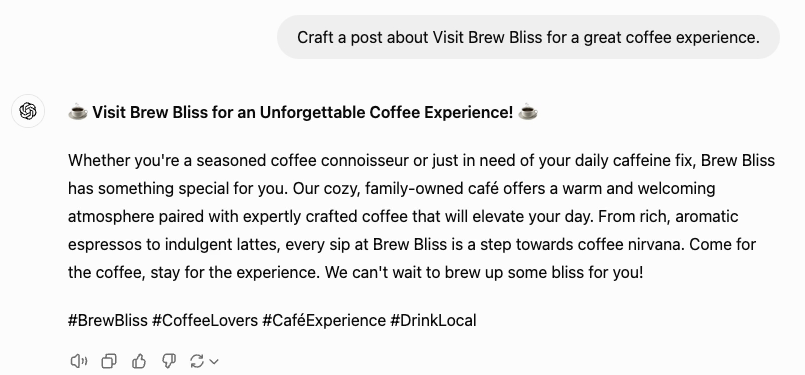
Original 2024 recording, Task 3. Prompt and initial draft visible at 03:35; Brew Bliss is a fictional practice brand.
Inspect this source image
Revision request · 03:35
Name the change you want.
The next instruction asks for sensory detail and a friendly, inviting tone. Those qualities give the learner something specific to look for in the next draft.

Original revision being prepared at 03:35. The full visible instruction, including its original wording and typos, is preserved.
Inspect this source imageChanged output · 04:00
More detail creates more to judge.
The revised draft adds a scene, coffee descriptions and audience cues. It is also longer. Specific claims about the café still need checking against the brief.
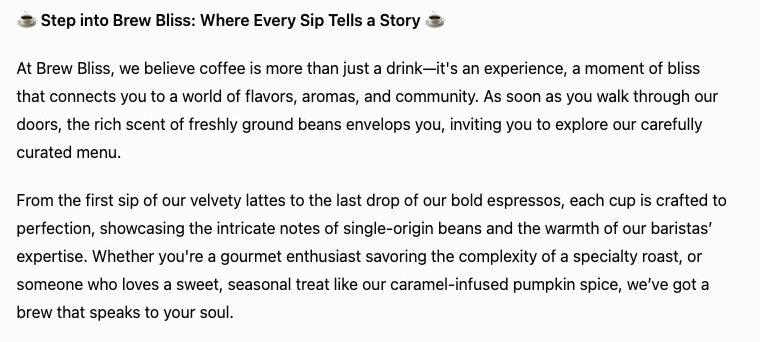
Original subsequent output at 04:00: headline and first two paragraphs. This is a changed demonstration draft, not a verified marketing result.
Inspect this source image
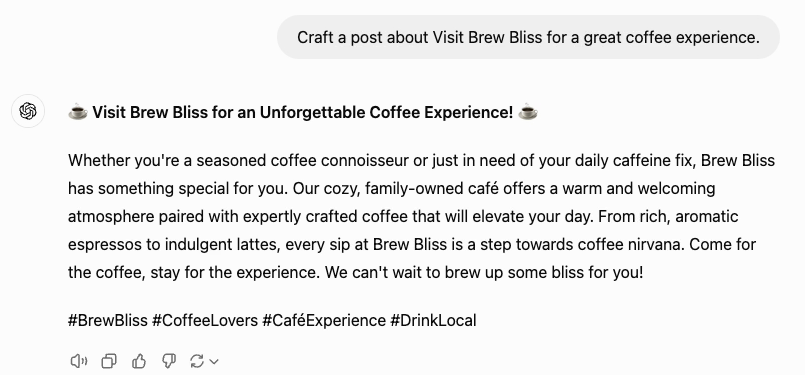

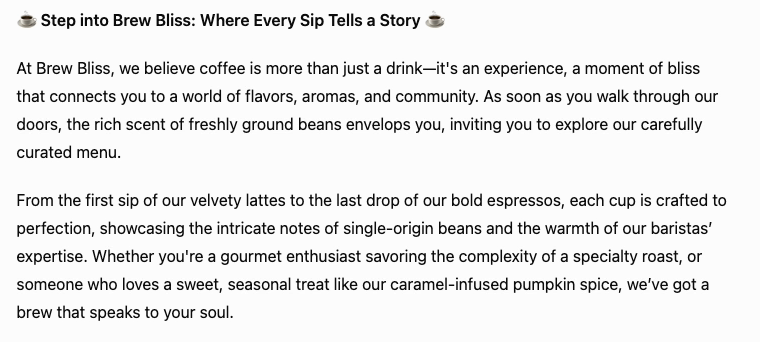
One sequence from my original Coursera lesson. The first request, revision being prepared, and subsequent output are recorded evidence; added café details are fictional practice material, not verified business facts.
Alternatives and constraints
- Alternatives
- Beginning with a fully specified prompt would hide the decisions that make the instruction useful. This example keeps the first request simple, then makes the revision visible.
- Constraints and tradeoffs
- The familiar subject lowers the barrier to practice, but it is still a fictional scenario. The model’s claims about the café need to be treated as generated draft material rather than verified business facts.
Evidence behind this account
At 03:35 in the original Task 3 recording, the initial request and its first generated post remain visible above the revision composer.
DECISION 02
Make the assessment test more than elimination.
A reviewer found distractors that were too obviously wrong, a definition-only question, and retry feedback that revealed answers. I recorded revisions to the choices, application context, feedback, and task references.
What the review changed
| Review finding | My documented revision | Design intent |
|---|---|---|
| Distractors were easy to eliminate | Reworked choices, especially Questions 7, 8, and 10 | Require a content judgment rather than spotting an implausible option |
| Question 7 asked only for a definition | Added application of the concept alongside its definition | Connect terminology with a use in context |
| Incorrect-answer feedback revealed the answer | Made retry feedback more neutral and pointed to the relevant lesson task | Let another attempt involve reviewing the material |
| Task references were wrong or pointed to optional work | Corrected references across the assessment | Direct learners to the instruction the question actually assessed |
These are documented formative revisions, not measured improvements in learner performance.
Alternatives and constraints
- Constraints and tradeoffs
- More plausible alternatives should better probe understanding, but the review record alone cannot tell us how learners performed. A future item analysis would examine errors and explanations.
Evidence behind this account
October 1, 2024 Course Shell Feedback and my October 4 review reply. The workbook records my changes as completed; its separate QA-approval fields do not establish individual final signoff.
DECISION 03
Connect the example to a repeatable review habit.
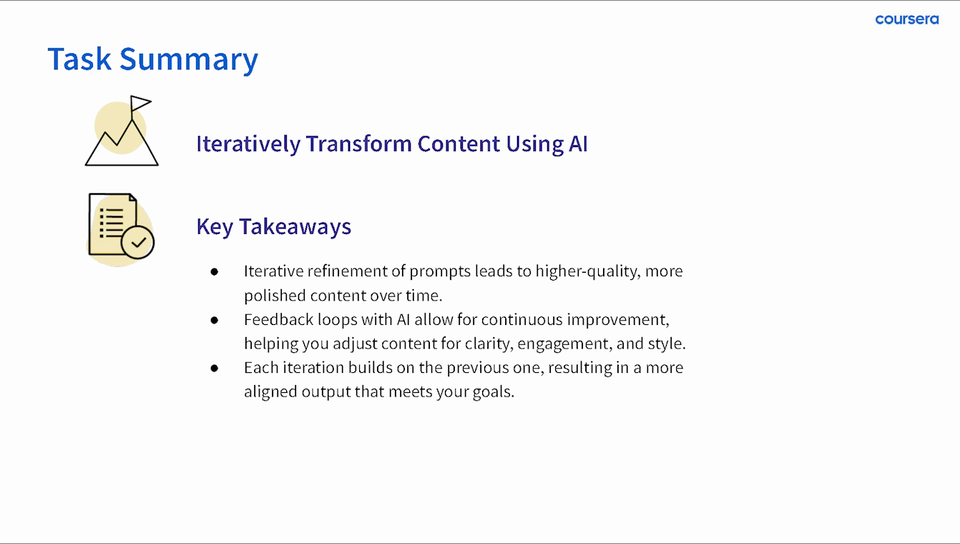
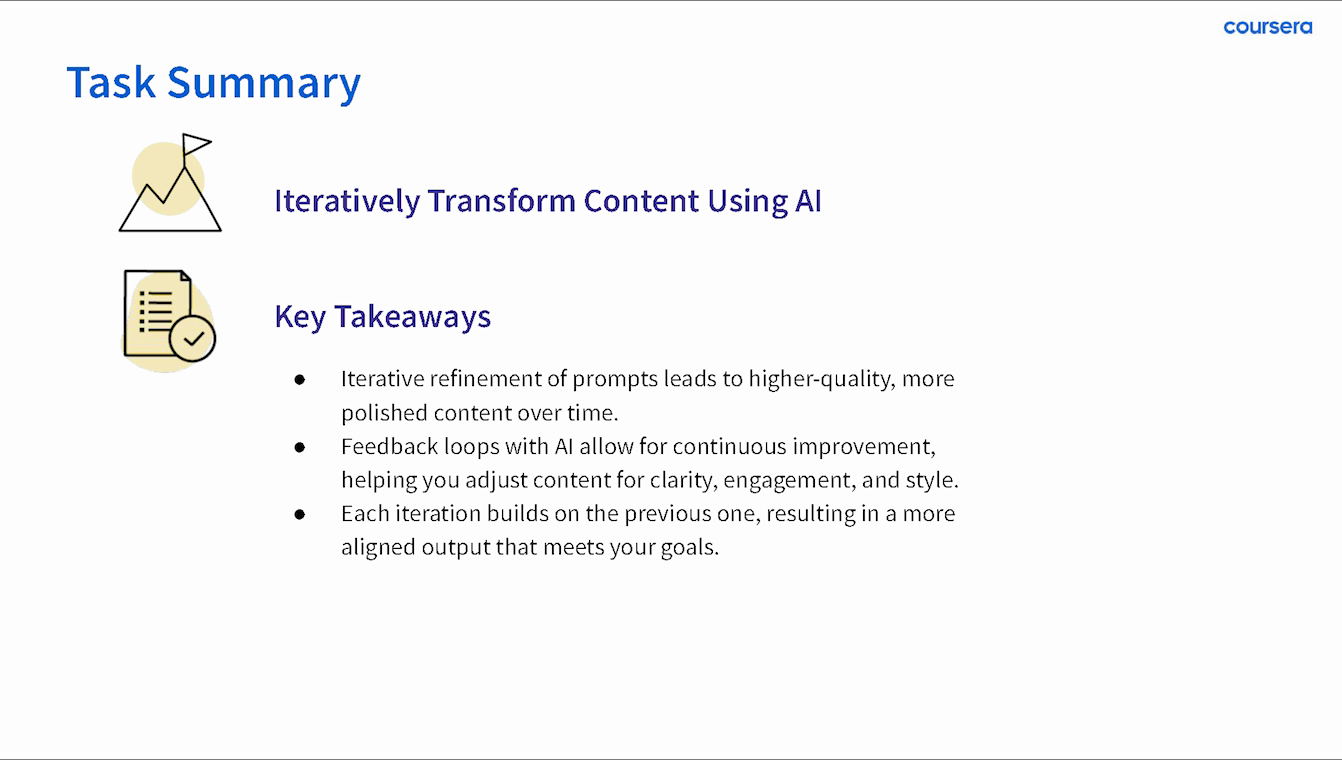
The Task 3 summary returns to drafting, reviewing, and refining against a goal. The broader project carries the work into a weekly content calendar, so prompting connects to an organized deliverable.
Read my proposed transfer-assessment questions
Questions I would use to test transfer
- What is this piece of content supposed to help the audience do?
- Which detail in the output is unsupported or does not fit the brief?
- What one instruction would you change, and what difference do you expect?
- How will you decide whether the next draft is useful enough for the intended post?
Proposed transfer assessment based on the recorded draft–review–revise activity. These questions are a portfolio retrospective, not a reported learner study.
This is a proposed next evaluation, separate from the course’s original expert-review process.
Alternatives and constraints
- Alternatives
- A collection of finished example prompts would give learners something to copy. The guided activity instead makes the initial draft, revision request, and changed output available to inspect.
- Constraints and tradeoffs
- Following a demonstrated sequence is easier than applying it independently. A completed lesson or enrollment count cannot tell us whether a learner can choose useful constraints for a new task.
Evidence behind this account
The original Task 3 summary and official project curriculum support the activity and calendar connection. The prompts below are a retrospective review checklist drawn from this example, not a claim that these exact assessment questions were used in the course.
How the work developed
- September 2024
Development and production
Objectives, practice tasks, scripts, slides, and recordings prepared for review.
- October 2024
Expert review and revision
Documented changes to assessment choices, application, feedback, and task references.
Public full lesson
A full teaching video published on my YouTube channel; the Guided Project is also available on Coursera.
OUTCOME & REFLECTION
A published project and an inspectable revision trail.
The course is published on Coursera with my instructor attribution. Its original lessons show the taught process, and the production review records concrete changes to the assessment. Together, those artifacts make both the learning experience and my response to critique visible.
A stronger lesson makes the review criteria visible too.
The recording shows that changing an instruction changes the draft. It also shows a risk: asking for richer language introduced concrete details such as single-origin beans and a caramel-infused pumpkin-spice drink that the visible revision request did not establish. Looking back, I would make the acceptance criteria clearer before the next revision: facts supported by the brief, appropriate length, intended audience, and a specific action. Then I would give learners a different business and ask them to diagnose the first answer before seeing a worked example. Their explanation of the next change would tell me more about transfer than a polished final post alone.
The next question I would test
Assess a new content task with a short explanation of the weakness, the chosen prompt change, and the reason the learner accepts or revises the next output.
Official Coursera course and instructor pages; original 2024 recordings and development workbook; October 2024 course-review records. Enrollment, completion, and demonstrated learning are different measures. No learner-gain claim is made here.
KEEP EXPLORING