Public beta
Prompt Compass
Check a prompt and compare revisions against the original requirements.
See the portfolio case kyle hobson
 Selected work
Compasses & MCPs / TOOL DESIGN · HUMAN REVIEW
I built a family of focused tools for reviewing prompts, examining claims, tracing research, and evaluating interfaces. Each has a different job and an explicit point for human judgment.
2 min overview · optional detail below
A family of focused tools
Make the next decision clearer.
Shared review habits. Distinct tools and evidence needs.
THE CHALLENGE
Open-ended AI feedback is hard to act on when observation, interpretation, and suggested changes are mixed together.
MY CONTRIBUTION
I turned recurring review tasks into focused tool workflows with structured inputs, inspectable outputs, and clear limits.
01 / Tool family
The tools share a principle, not a single catch-all prompt. Each asks for different evidence and produces a different kind of help. MCP connections let an AI assistant call these focused tools within a larger workflow.
Public beta
Check a prompt and compare revisions against the original requirements.
See the portfolio casePublic beta
Turn screenshots and a task flow into structured findings and a reviewable report.
Open the project storyPublic beta
Examine evidence gaps, hidden assumptions, framing, and missing perspectives.
Explore Critical CompassLocal alpha
Frame a question and distinguish source evidence from interpretation.
See the Oppia editionLocal alpha
Support a game master with hooks, characters, and rules-aware preparation.
02 / Actual output
UX Heuristics Compass separates the observation, evidence, severity, and next action. The report gives a designer or teammate a specific finding to discuss. A score summarizes the supplied review; it does not replace testing with people.
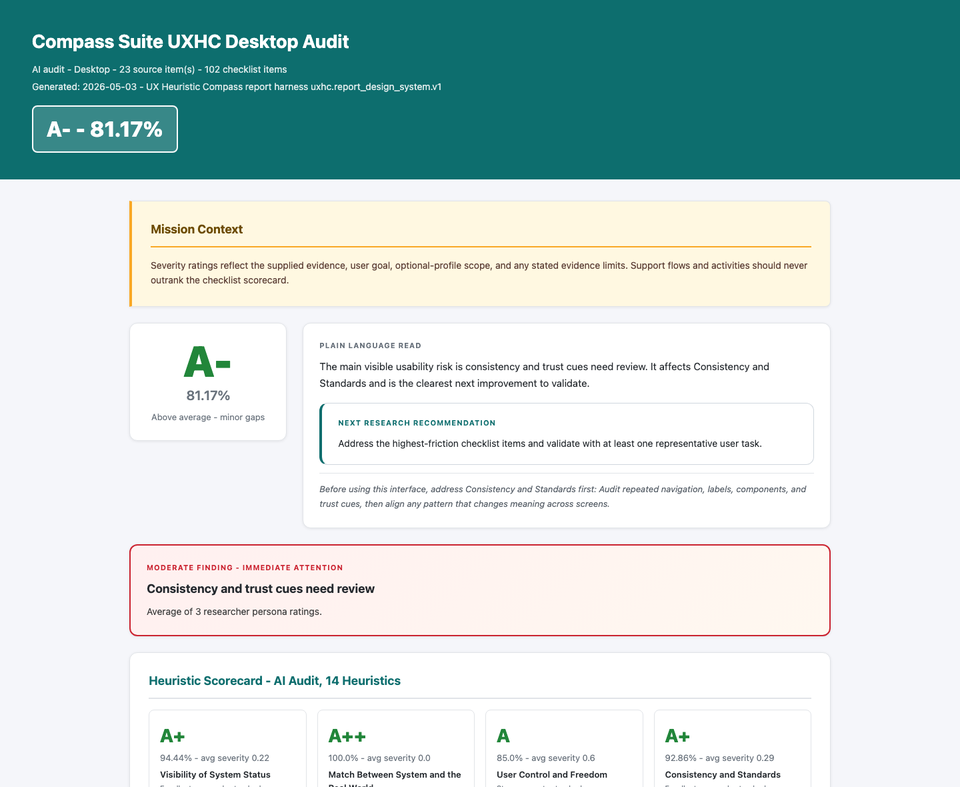
Actual May 2026 AI-assisted audit of the Compass site at that time. It is an example output, not a current site rating or a user-study result.
Inspect screen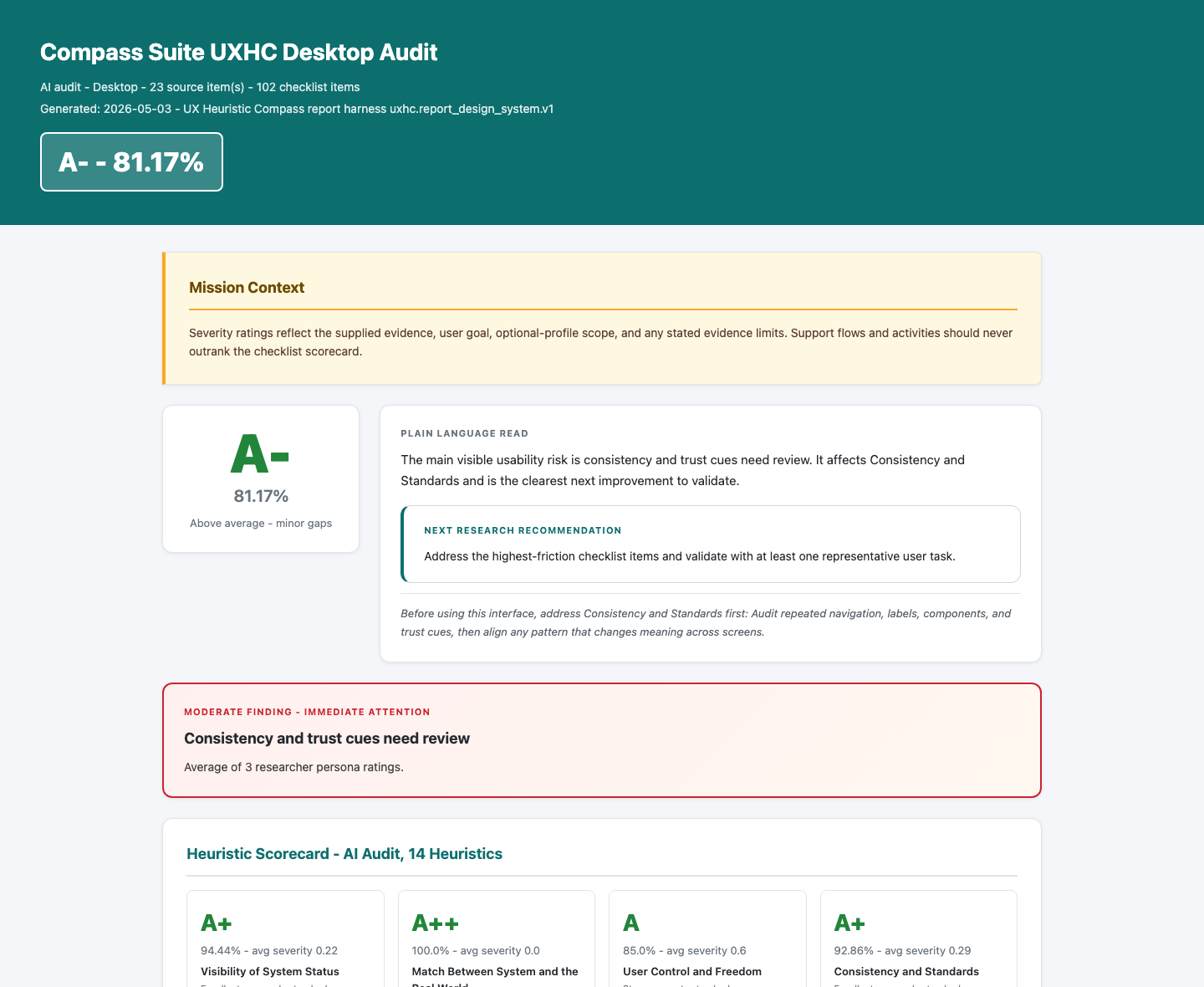
03 / Workflow
A tool can organize what to inspect. I design the handoff so a person can question the evidence, revise the interpretation, or ask for a better source before acting.
Shared pattern across distinct tools
A task, draft, or interface evidence.
A focused tool organizes the review.
A person checks the finding and its limits.
Revise, investigate, or keep the decision.
WHERE IT LANDED
The public betas include examples, setup guidance, and source packages. The private tools remain separate. Together they demonstrate how I turn expert review habits into workflows an AI assistant can support.
More tools are useful only when the boundaries are clear. A claim checker, a prompt reviewer, and a usability audit should not pretend to certify the same thing.
I would test whether a new user can choose the right tool and understand when to challenge its output.
Evidence: original tool READMEs, public release pages, and the archived UX Heuristics Compass report. No adoption or measured productivity gain is claimed.
KEEP EXPLORING
A GOOD PLACE TO START
For applied AI consulting, AI analysis, prompt design, enablement, and human–AI product work.
Prefer email?
JonathanKyleHobson@gmail.com