
 Selected work
Oak AI / QUALITATIVE RESEARCH · AUDIENCE FIT
Test the audience assumption before going deeper.
Qualitative research in privacy-focused communities surfaced concerns about security, accountability, and control, and raised a harder question about audience fit.
8 min read
- The question
- Did a privacy-focused audience's concerns match what Oak was asking its product to do?
- The evidence
- September 2024 community observation and Dovetail coding; the retained export is a partial record.
- The decision
- Make concerns about data protection, accountability, and control explicit before investing in deeper research.
THE CONTEXT
Understanding privacy language was only part of understanding the need.
Oak was exploring how VibeCheck might help people make sense of privacy policies and terms of service. The research looked at privacy-focused community discussions to understand the concerns around that idea. The material reached beyond difficult wording into data collection, security, corporate responsibility, and practical control.
The product context and constraints
I coded community material in Dovetail and synthesized it for persona and product discussions. The retained export separates source notes from synthesis notes and preserves topic tags and observation dates. It gives a trace of the analysis, even though it does not contain the full study record.
The work raised a consequential choice. We could refine the explanation and guidance proposed for VibeCheck, or reconsider how closely this audience's priorities matched the proposed product. Those directions required different next research questions.
Constraints that shaped the work
- The retained coding excerpt comes from a purposively selected privacy community, not a representative market sample.
- The archive includes passive observation material, a proposed active-engagement strategy, and a retrospective description of engagement. These sources need to remain distinct.
- Tag frequency, community reactions, and composite personas cannot establish population prevalence, willingness to adopt, or a person's occupation or demographics.
- Public visuals omit source excerpts, identities, and private locators; they show the coding structure and paraphrased synthesis.
MY CONTRIBUTION & COLLABORATION
I examined and coded community material, synthesized themes, and contributed to the discussion of personas and research priorities. A later project retrospective describes pausing planned deeper interviews and reorienting the product and message. The original coding supports the concerns; it does not independently prove the final market conclusion.
DECISION 01
Separate what people discussed from what we invited them to discuss.
Community observation exposed concerns already being discussed: how data was collected, how it was protected, and whether companies were accountable. I tagged source excerpts and kept them available for synthesis rather than reducing the material to a single label of trust.
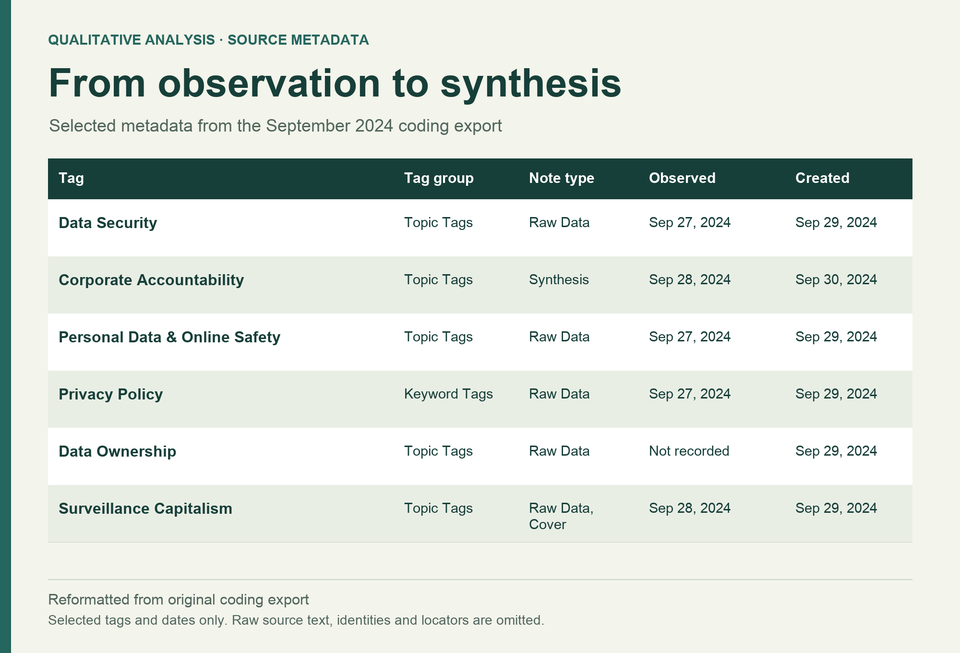
What the retained coding structure shows
| Selected tag | Tag group | Note type in the displayed excerpt | Observation record |
|---|---|---|---|
| Data Security | Topic Tags | Raw Data | September 27, 2024 |
| Corporate Accountability | Topic Tags | Synthesis | September 28, 2024 |
| Personal Data & Online Safety | Topic Tags | Raw Data | September 27, 2024 |
| Privacy Policy | Keyword Tags | Raw Data | September 27, 2024 |
| Data Ownership | Topic Tags | Raw Data | Not recorded in the selected row |
| Surveillance Capitalism | Topic Tags | Raw Data, Cover | September 28, 2024 |
These rows demonstrate the retained coding structure. They are not participants, a complete codebook, or a count of distinct findings. A tag may appear on multiple notes and note types.
Alternatives and constraints
- Alternatives
- The archive also contains an active-engagement plan intended to elicit more conversation. That approach could surface additional detail, but its proposed prompts emphasized frustration and product-adjacent concerns. Responses to those prompts would need to be interpreted separately from unprompted discussion.
- Constraints and tradeoffs
- Observation can reveal language and recurring concerns without asking people to react to a product pitch. It still reflects the community and material selected for review. Active questions can go deeper, while also shaping the topics and tone of the replies.
Evidence behind this account
The source export includes raw-data and synthesis note types, topic and keyword tags, and late-September observation and creation dates. It is a partial analysis record. The proposed engagement plan is not a transcript of conversations that occurred.
DECISION 02
Turn a broad concern into a product question.
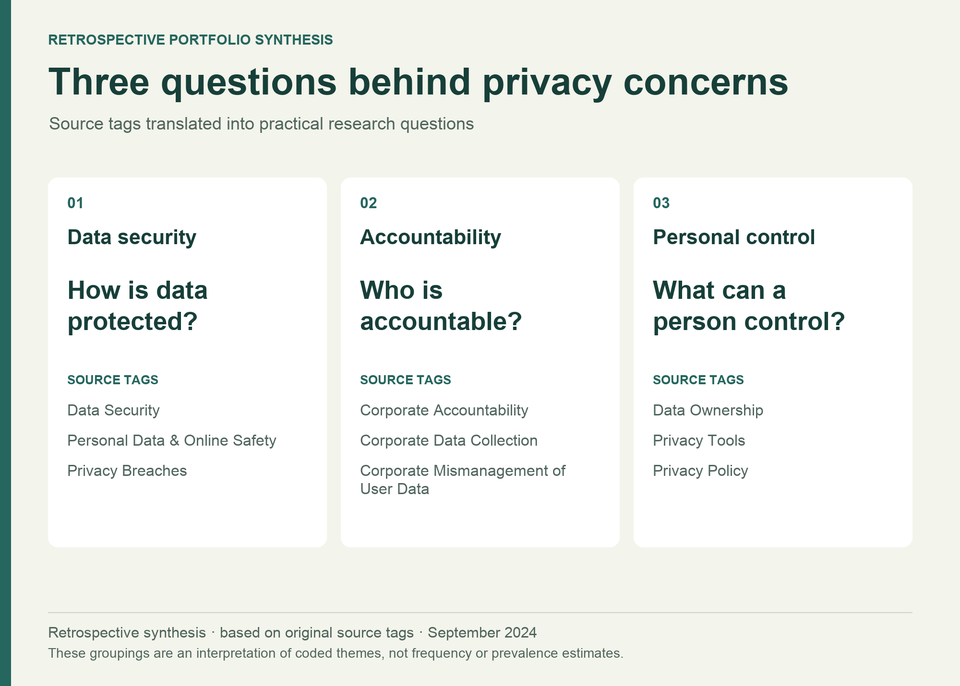
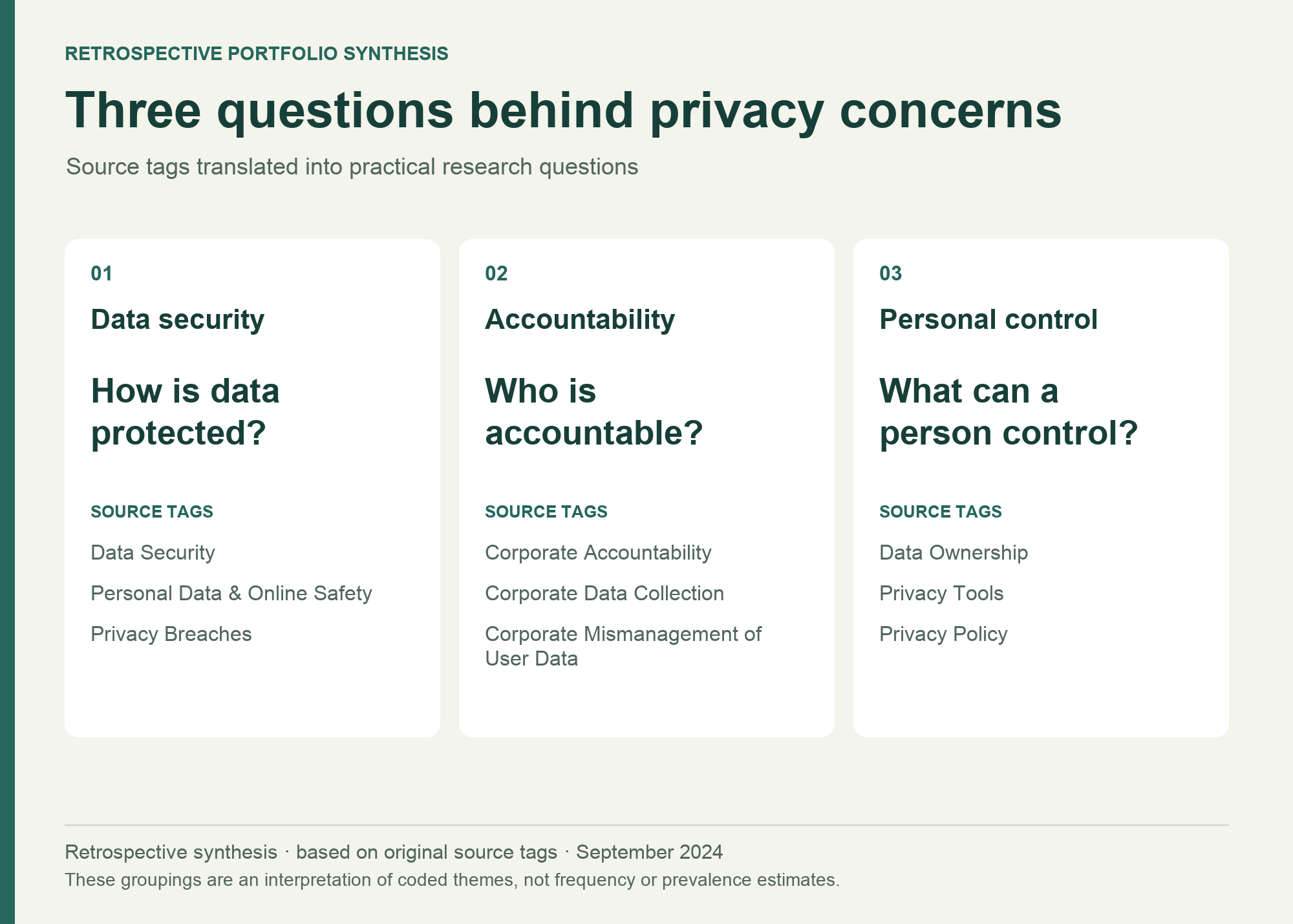
The synthesis distinguished concerns about data protection, corporate conduct, and usable control. It also described difficulty understanding privacy choices. Those concerns suggested different questions for a product that might explain policies and terms.
Three different questions behind trust
| Theme in the source | Concrete concern in the synthesis | Implication to investigate |
|---|---|---|
| Data security | How information is collected, stored, and protected. | What evidence would help someone assess a service's data practices? |
| Corporate accountability | Whether organizations take responsibility for data use and breaches. | Does the product explain a practice, or provide an actionable way to respond to it? |
| Personal control | Difficulty understanding privacy choices and practical protective steps. | Can a person turn the explanation into a choice, setting, or alternative they can use? |
Themes identify issues to investigate. They are not estimates of how common a view is or evidence that the proposed product met the need.
Alternatives and constraints
- Alternatives
- The early synthesis proposed simpler explanations, clearer guidance, and product messaging about accountability. Another question remained: would understanding a policy address the person's underlying concern about what an organization actually does? The research needed to keep that distinction open.
- Constraints and tradeoffs
- A clear explanation could make a privacy decision easier to understand. It would not, by itself, change a company's data practices or demonstrate that a person had more control. That distinction kept the promise under examination connected to the underlying need.
Evidence behind this account
The source contains the coded themes and an early set of recommendations. The practical questions below are a retrospective portfolio synthesis, not a verbatim interview guide, ranked finding list, or proof that the proposed product supplied these capabilities.
DECISION 03
Choose the uncertainty worth studying next.
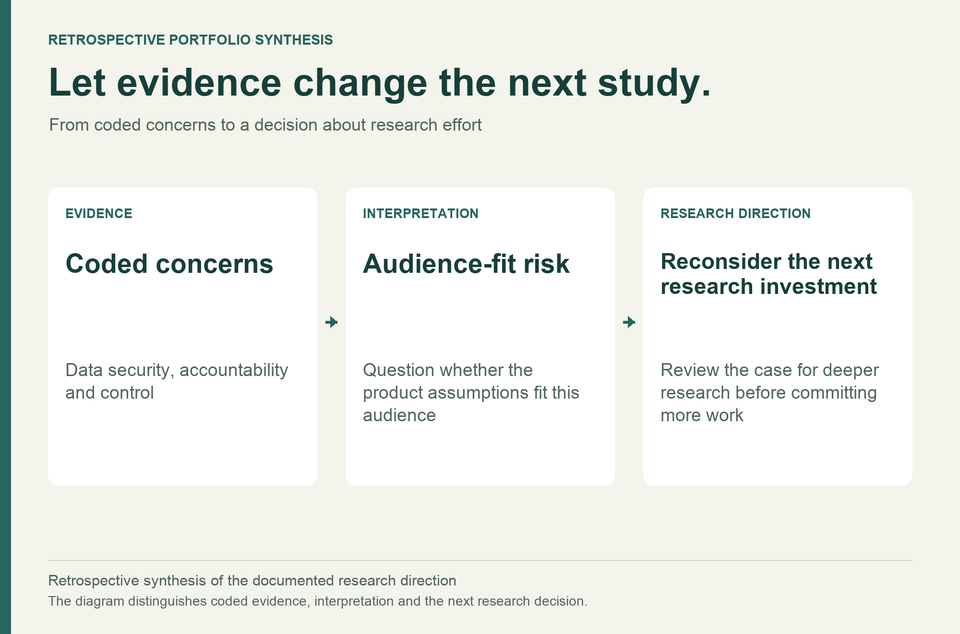
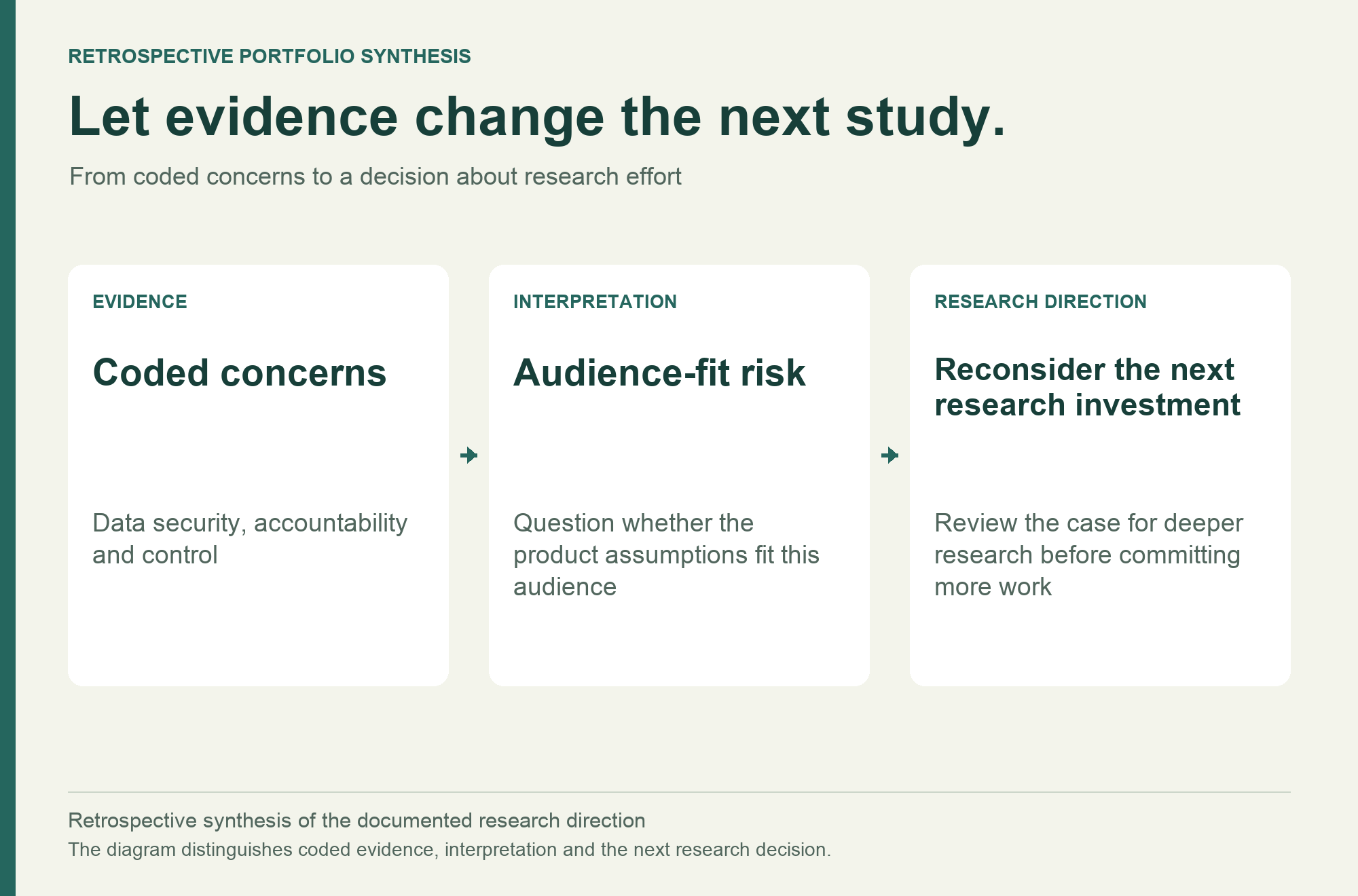
The analysis raised a question about whether the audience needed a better explanation of privacy terms, a different kind of help, or a level of control the proposed direction did not establish. Deeper interviews in the same direction would only be useful if their purpose was clear.
Two directions the evidence put into view
| Direction | Evidence connection | Uncertainty it would address | Status in the retained sources |
|---|---|---|---|
| Refine the explanation and guidance | The early synthesis proposed simpler policy breakdowns and more actionable privacy guidance. | Does this help with a concrete decision the person already needs to make? | Source-documented proposal; adoption not demonstrated. |
| Reconsider the audience before deeper research | Concerns extended into security, accountability, and control; the retrospective records pausing planned deeper interviews. | Is this audience's central need well matched to the proposed product? | Retrospective account of the research direction; no definitive market-fit conclusion. |
The evidence does not establish a budget saved, adoption probability, or a better-performing replacement audience.
View the supporting image
Alternatives and constraints
- Alternatives
- One direction was to refine the proposed explanation and guidance, then examine a concrete privacy decision. Another was to pause the planned deeper study and reconsider audience fit. The early synthesis supports the first direction as a proposal; the later project retrospective records the second as the direction taken.
- Constraints and tradeoffs
- Pausing a study can preserve room to investigate a different uncertainty, but it also leaves questions unanswered. The community analysis could surface a fit risk. It could not prove that no one in the audience would adopt or that another segment would be a better market.
Evidence behind this account
The retained sources support a cautious account: coded concerns informed a discussion that reconsidered the next research investment. The retrospective describes halted deeper interviews and product/message reorientation; the underlying dated decision record and a comparison with another audience are not present here.
How the work developed
- September 25–28, 2024
Observation dates in the retained source
Source notes in the coding export record late-September community observations. This is not the full study's established date range.
- September 29–30, 2024
Coding and synthesis records
The retained export records tags and source/synthesis entries created in late September.
Research direction reconsidered
The later project retrospective records pausing deeper interviews and revisiting the product and message. The decision date is not established in the retained sources.
OUTCOME & REFLECTION
A sharper question about whom to serve next.
The work produced coded qualitative material and an audience synthesis that supported reconsidering the next research investment. It helped the team challenge an early assumption before committing to a deeper study in the same direction.
Make the analysis capable of challenging the product idea.
Looking back, I would separate community observation, prompted discussion, and interpretation more explicitly in the research plan. Some proposed engagement prompts leaned toward frustration and the product's area of interest. I would revise those questions to invite contrary examples and current workarounds, so the next study could test the assumption as readily as elaborate it.
The next question I would test
Compare concrete privacy tasks across this audience and another plausible audience using explicit recruitment criteria. Ask about recent choices, alternatives, and current workarounds before introducing the product concept. Keep observations, participant accounts, and product hypotheses distinct in the synthesis.
September 2024 qualitative coding export and reviewed project retrospective. The retained source is partial and includes a privacy-community sample; no population prevalence or definitive product-market-fit conclusion is claimed. Visuals reformat source metadata and paraphrase themes; they do not reproduce participant quotations.
KEEP EXPLORING