
 Selected work
Oak AI · Creator audience research / SURVEY RESEARCH · PRODUCT DIRECTION
Find what stands between interest and action.
An audience survey showed why caring about an issue did not always lead to taking the next step. The findings helped shape a proposed Action Hub.
9 min read
- The question
- What keeps an engaged audience from taking action, and what kind of support would help?
- The evidence
- 1,459 completed submissions in the March 14, 2025 report snapshot; a voluntary audience sample.
- The decision
- Recommendations for a proposed Action Hub: clearer steps, reusable templates, reminders, and feedback about impact.
THE CONTEXT
Enthusiasm did not explain the effort of following through.
Oak and creator Qasim Rashid were exploring how to help an audience act on issues they cared about. The survey needed to distinguish several things that could look similar from a distance: paying attention, intending to act, finding a useful action, and following through.
The product context and constraints
I led survey design, launch, and analysis, bringing quantitative questions together with open responses. The report looked at audience context and platform behavior, reported obstacles, and interest in possible support. That gave the product discussion more to work with than a general expression of enthusiasm for a new tool.
The evidence supported an audience-specific direction. It did not tell us that the same people would use a new product repeatedly or pay for it. The useful output was a clearer set of problems to address and a narrower next experience to test.
Constraints that shaped the work
- Recruitment reached a voluntary creator and advocacy audience, including people who did not directly follow Qasim.
- The March 14 count was recorded while the survey was still live; it is a submission snapshot, not a final count of unique, quality-checked participants.
- The retained report does not preserve each question's response base, complete wording, skip logic, or cleaning decisions.
- Reported barriers and feature requests describe perceptions and preferences. They do not establish a causal effect on real-world action.
MY CONTRIBUTION & COLLABORATION
I led the survey work and synthesized the findings into recommendations for the Oak and creator collaboration. The findings report is a team artifact; the Action Hub was a proposed product direction, not a product outcome measured by this study.
DECISION 01
Ask about the work between attention and action.
The original objectives covered audience behavior, barriers, calls to action, and follow-through. Asking about those areas together made it possible to separate interest in a cause from the difficulty of deciding what to do next.
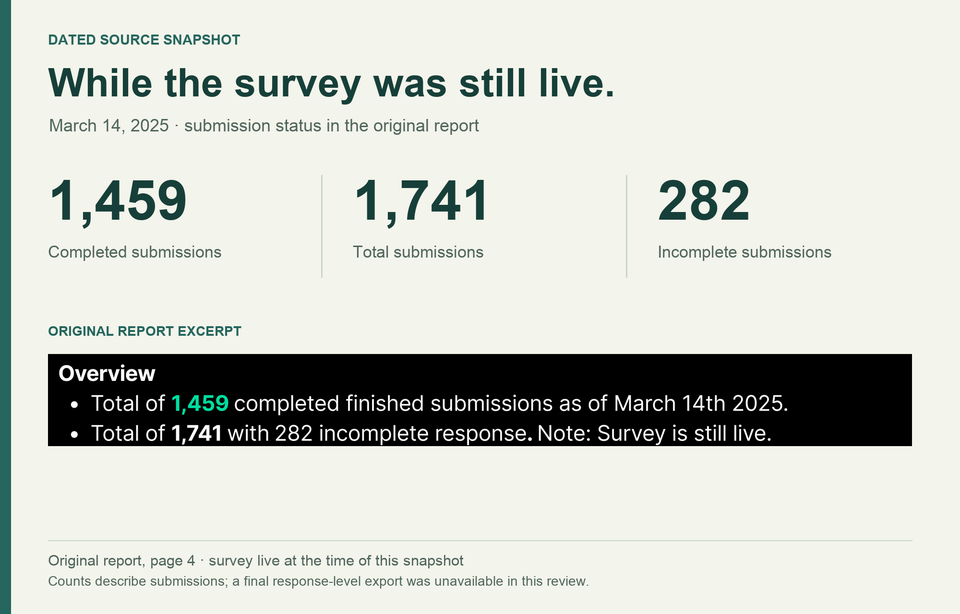
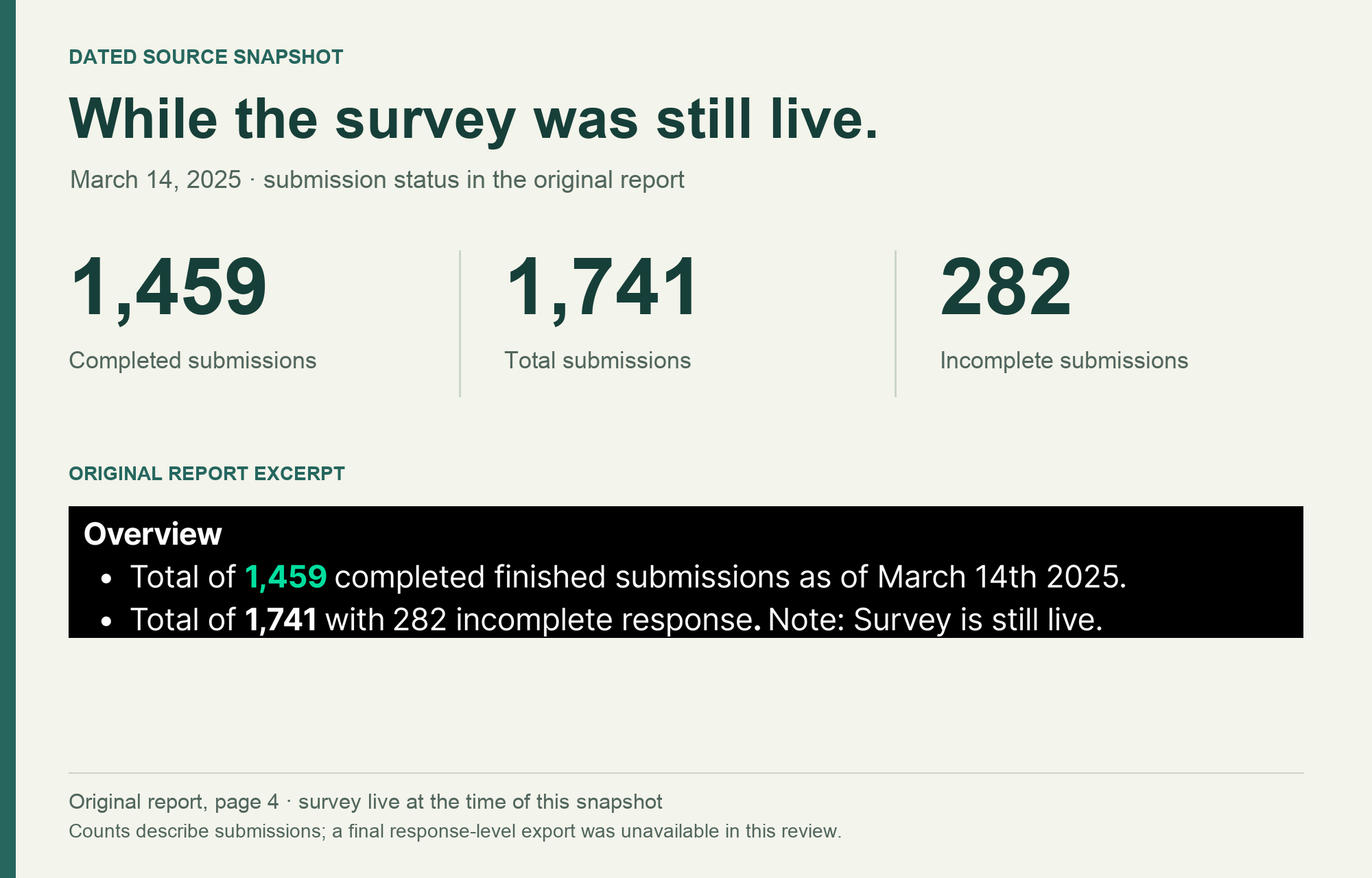
The sample at the recorded checkpoint
- Completed submissions
- 1,459
- Incomplete submissions
- 282
- Total submissions
- 1,741
- Checkpoint
- March 14, 2025; survey still live
Reformatted from the original report, page 4. Counts describe submissions at a dated checkpoint.
Voluntary audience sample. The final response-level export and quality checks were unavailable in the retained evidence.
Alternatives and constraints
- Alternatives
- A question about interest in an action-support tool was part of the report, but it could not stand in for the behavior and barrier questions. The research frame kept both the appeal of a possible tool and the circumstances of action in view.
- Constraints and tradeoffs
- The survey gave us a broad view of this audience's self-reports. It provided less detail about how a specific person moved through a real action from start to finish. That remained a question for follow-up research.
Evidence behind this account
The original report states 1,459 completed, 282 incomplete, and 1,741 total submissions as of March 14, 2025, while the survey was still live. These are report counts, not a final deduplicated sample.
DECISION 02
Distinguish a hard choice from a shortage of resources.
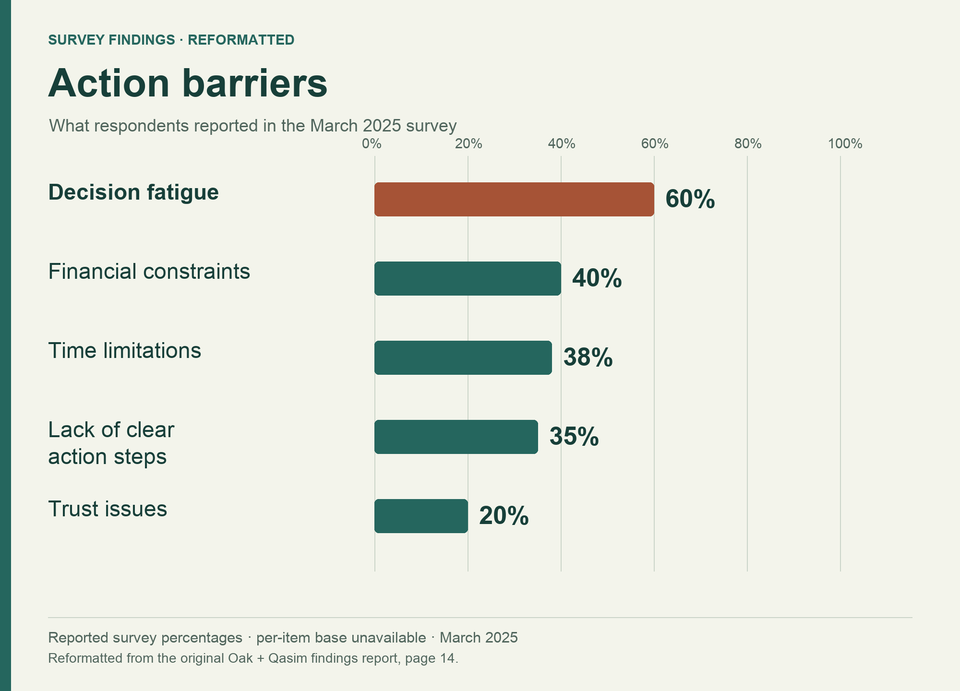
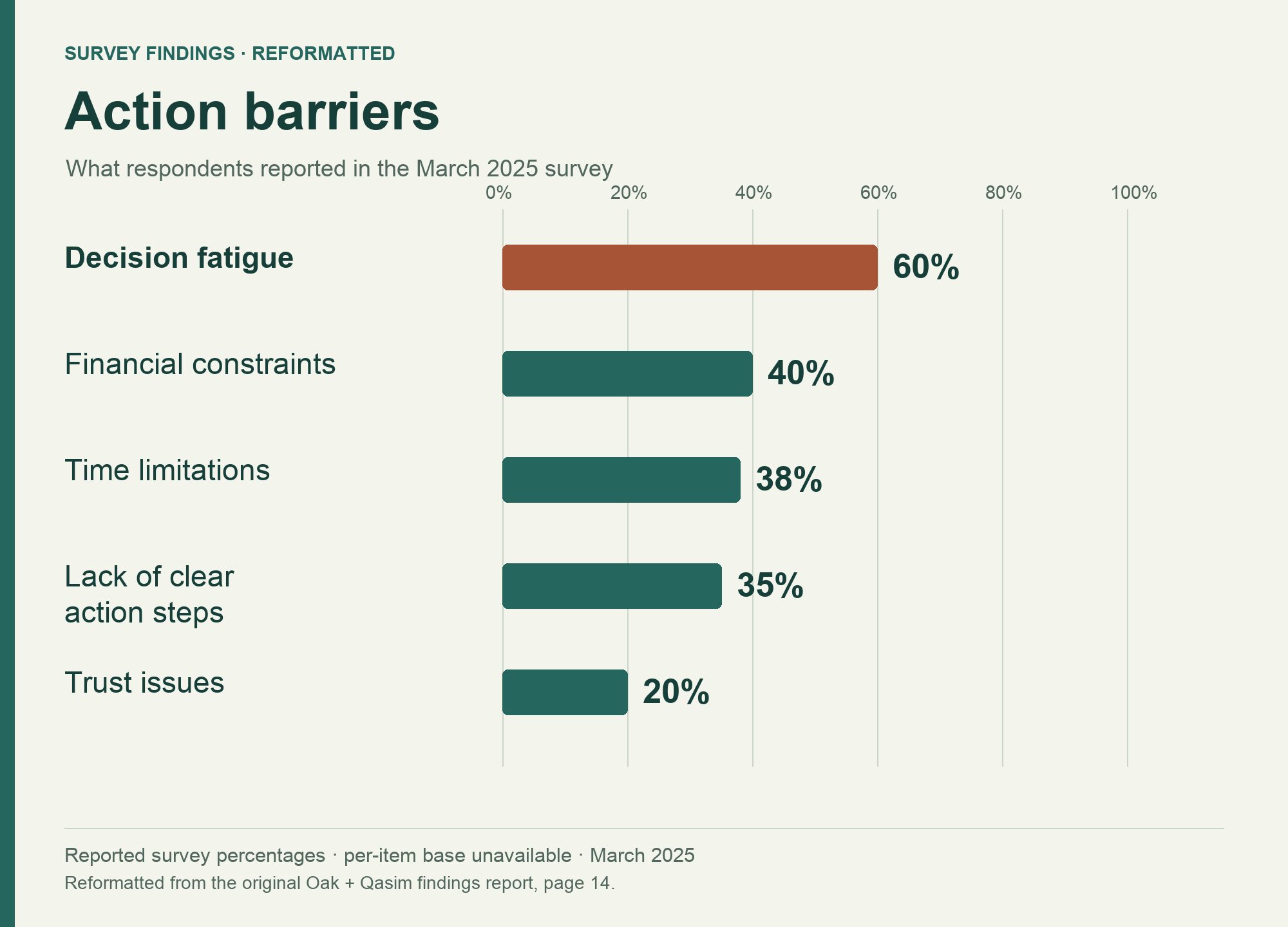
The report's largest listed barrier was decision fatigue: too many issues, calls to action, or steps to work through. Money, time, unclear instructions, and doubts about effectiveness appeared alongside it. Those obstacles suggested different kinds of support.
Read the five reported barriers and their limits
Five reported barriers
| Barrier | Reported percentage | What the report describes |
|---|---|---|
| Decision fatigue | 60% | Too many issues, calls to action, or steps. |
| Financial constraints | 40% | Limited money or resources available for action. |
| Time limitations | 38% | A busy schedule constraining involvement. |
| Unclear action steps | 35% | A need for specific, easy-to-follow instructions. |
| Trust issues | 20% | Doubts that an action would be effective. |
Directional self-report from a voluntary audience. The rows are not mutually exclusive categories established by the retained documentation.
Alternatives and constraints
- Alternatives
- Treating every obstacle as a need for more information would miss the distinction. A clear instruction could help someone understand a step, while limited time or money could still prevent them from taking it.
- Constraints and tradeoffs
- The percentages made the reported pattern easy to see, but the retained report does not include a response base for each item. I would use the pattern to frame candidate improvements, not to estimate how many people in a wider population had each need or to calculate how much a feature would help.
Evidence behind this account
The five reported percentages appear in the original March 2025 findings report. The underlying response bases, item overlap, and question logic are unresolved, so the figures should not be added together or converted to respondent counts.
DECISION 03
Follow one finding into a testable next step.
The report connects reported obstacles with requests for practical support. Here is one path through that evidence: unclear action steps, requests for templates and simpler instructions, and a focused first-action flow I would test next.
Reported barrier
35%: unclear action steps
The report describes a need for specific, easy-to-follow instructions. This is one of five reported barriers; its per-item response base is unavailable.
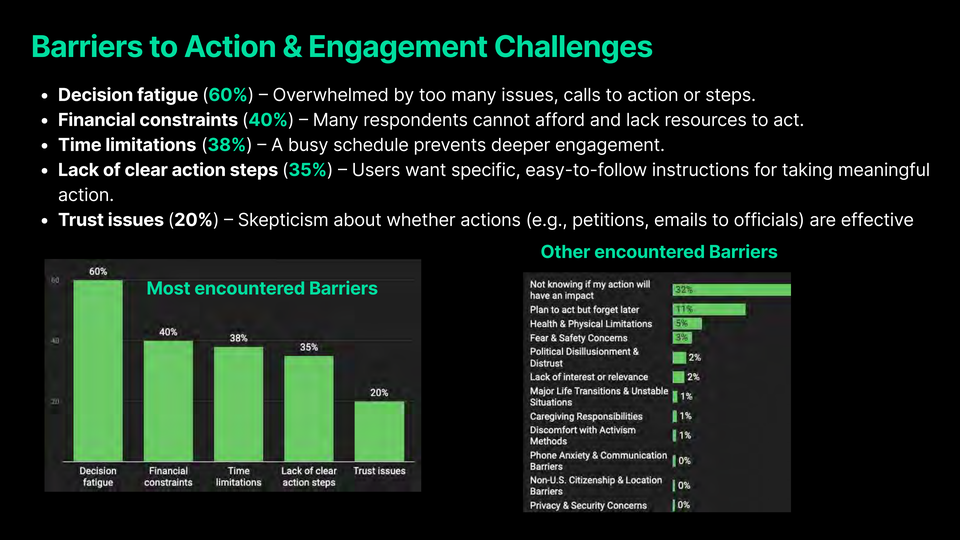
Original March 2025 findings report, page 14. Reported percentages describe this voluntary audience; the retained report does not preserve each item’s response base.
Inspect this source image
Requested support
Templates and simpler steps
The report also summarizes requests for pre-filled outreach templates and simplified action steps. These requests suggest support worth exploring.

Two selected feature requests from the original report, page 15. Exact crop. “Do this one thing today” is the report’s example, not a participant quotation; the list gives no request frequencies.
Inspect this source imageMy proposed next test
One action, with enough help to start.
I would test a focused outreach task with an editable template. The point is to see whether someone can move from understanding the request to taking the first step.
- Choose a relevant action and explain what it involves.
- Adapt the template accurately to their situation.
- Complete the first step, then identify what confirmation or support they need.
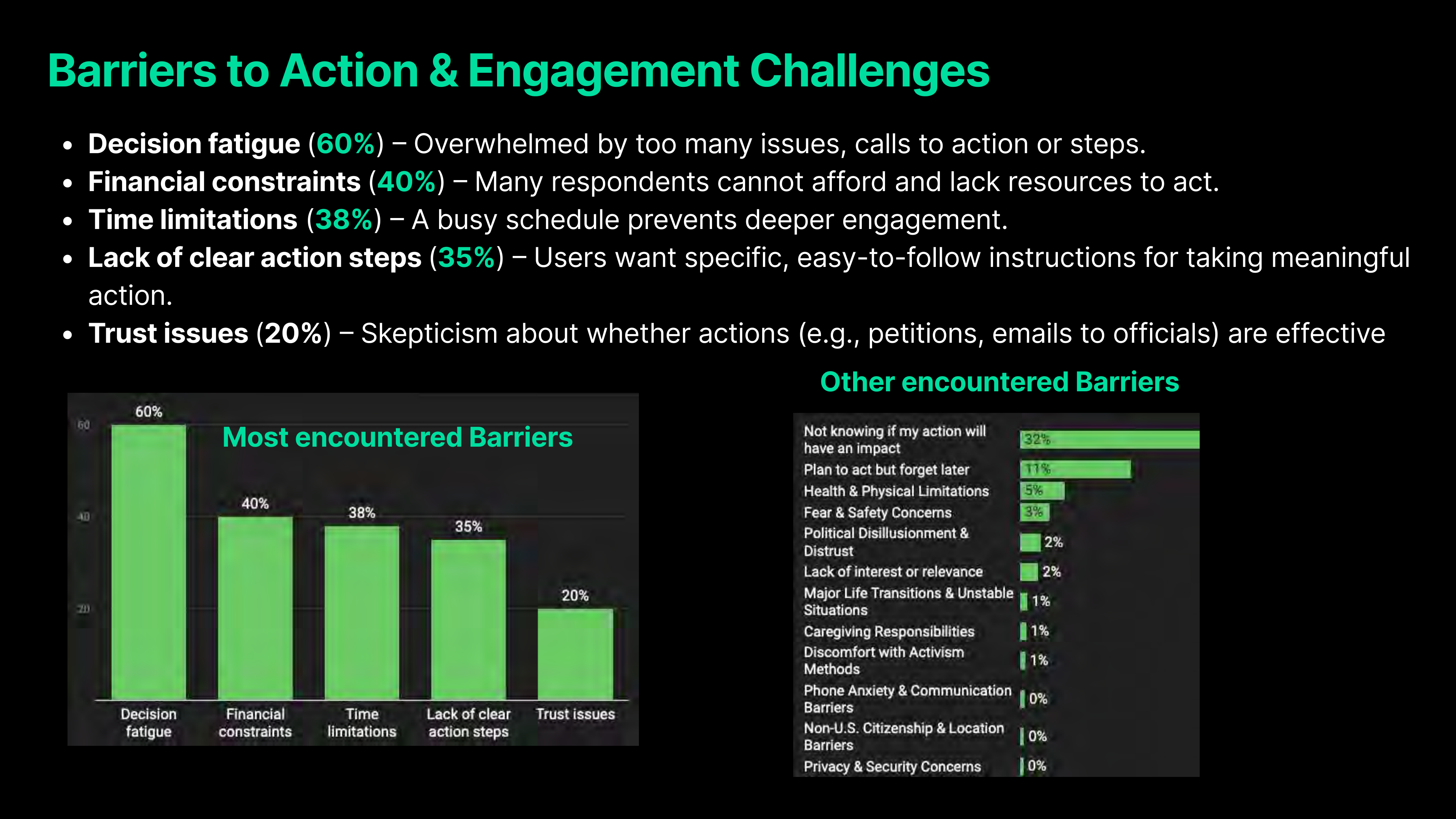

Connecting these two report sections is my interpretation; it does not establish that the same respondents selected both. The first-action flow is a proposed next test, not a tested interface or a measured Action Hub result.
Explore the full finding-to-recommendation trace
From reported obstacle to proposed support
| Reported obstacle | Support requested in the report | Implication for the proposal | What remains to test |
|---|---|---|---|
| Decision fatigue · 60% | Simplified action steps | Give a person one clear starting action to consider. | Can they choose a relevant action and explain what it involves? |
| Unclear action steps · 35% | Pre-filled templates and easy-to-follow steps | Reduce the blank-page work of starting an outreach task. | Can they adapt the template accurately and complete the first step? |
| Time limitations · 38% | A place to organize tasks and reminders | Help a person retain and return to an intended action. | Does that support fit the time they actually have, or add another task to manage? |
| Trust issues · 20% | Ways to verify impact after acting | Explain what is known about the result of an action. | What evidence of impact can the product supply without overstating attribution? |
| Financial constraints · 40% | No directly corresponding financial-support feature established in the inspected report | Keep this constraint visible; templates and reminders do not resolve it. | Which actions are feasible within the person's available resources? |
All percentages are reported values with per-item bases unavailable. The Action Hub remained a proposed direction in the evidence used here; adoption, revenue, and behavioral impact were not measured.
Alternatives and constraints
- Alternatives
- The next product discussion could focus on a specific action a person could start and finish, with enough support around it. A larger catalogue of information would not, by itself, answer the reported difficulty of choosing and following through.
- Constraints and tradeoffs
- The requested support addressed some parts of the problem more directly than others. A template could reduce the effort of starting a message; it would not remove a financial constraint or prove that the message had an effect. Those limits mattered when defining what the proposal could reasonably promise.
Evidence behind this account
The original report contains the barriers and requested features. This trace is a portfolio synthesis linking them; it is not an original ranked requirements matrix, a committed roadmap, or evidence that these features changed behavior.
How the work developed
- March 2025
Audience survey and findings report
Survey work combined questions about audience context, behavior, barriers, and possible support.
Recorded submission checkpoint
The report recorded 1,459 completed submissions out of 1,741 total while the survey was still live.
Recommendations for the proposed Action Hub
The project retrospective connected the research to an Action Hub direction and follow-up research. A dated implementation decision is not established by the retained report.
OUTCOME & REFLECTION
A product direction grounded in the effort of acting.
The study produced an audience findings report and recommendations for a proposed Action Hub. It connected the audience’s reported obstacles to specific forms of support the team could explore: a clear step, a useful template, a reminder, and visible impact.
A feature request is the start of a hypothesis.
The most useful next step would be to take one of the proposed supports into a real task. I would begin with choosing and starting an action, then observe where the person hesitates or needs a different kind of help. I would also keep the report's financial barrier in view, even though it does not lead as neatly to a template or reminder feature.
The next question I would test
Use a focused action flow with intended audience members. Check relevance, comprehension of the commitment, completion of the first step, and what evidence of impact they expect. Recover the instrument and item bases before making comparisons between audience segments.
March 2025 Oak / Qasim survey findings report and reviewed project retrospective. Counts are the March 14 snapshot, not a final deduplicated sample. Voluntary self-report limits generalization; product adoption and business impact were not measured in the supplied evidence.
KEEP EXPLORING